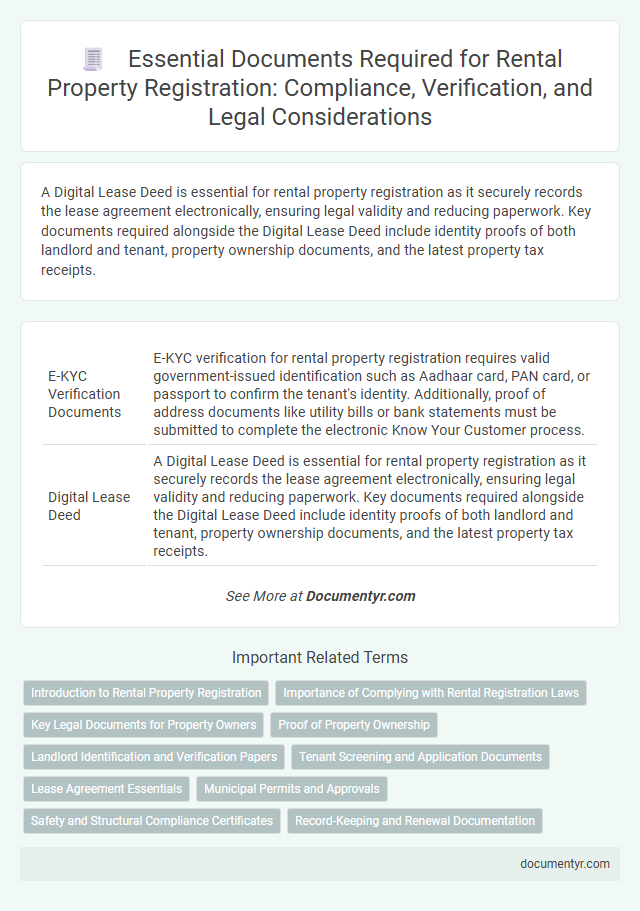
To register a rental property, essential documents typically include proof of ownership such as title deeds, a valid government-issued ID of the property owner, and the rental agreement or lease contract. Additional paperwork may involve property tax receipts, occupancy certificates, and No Objection Certificates (NOCs) from relevant local authorities. Ensuring all documents are accurate and up-to-date streamlines the registration process and complies with legal requirements.
What Documents are Necessary for Rental Property Registration?
| Number | Name | Description |
|---|---|---|
| 1 | E-KYC Verification Documents | E-KYC verification for rental property registration requires valid government-issued identification such as Aadhaar card, PAN card, or passport to confirm the tenant's identity. Additionally, proof of address documents like utility bills or bank statements must be submitted to complete the electronic Know Your Customer process. |
| 2 | Digital Lease Deed | A Digital Lease Deed is essential for rental property registration as it securely records the lease agreement electronically, ensuring legal validity and reducing paperwork. Key documents required alongside the Digital Lease Deed include identity proofs of both landlord and tenant, property ownership documents, and the latest property tax receipts. |
| 3 | Property Tax E-Receipts | Property Tax E-Receipts are essential documents for rental property registration, serving as proof of paid property taxes and validating ownership status. These electronic receipts must be submitted along with the property deed, identity proofs, and rental agreement to complete the registration process. |
| 4 | Title Chain Certification | Title chain certification is essential for rental property registration as it verifies the legal ownership history and confirms there are no disputes or encumbrances on the property. This document ensures the rental property is free from any legal liabilities, providing a clear and valid title for registration purposes. |
| 5 | Encumbrance Certificate (EC) | An Encumbrance Certificate (EC) is essential for rental property registration as it proves the property is free from legal liabilities or mortgages, ensuring clear ownership for leasing. This document, issued by the sub-registrar's office, verifies all registered transactions on the property, safeguarding both landlords and tenants during the rental agreement process. |
| 6 | No Objection Certificate (NOC) from Society | A No Objection Certificate (NOC) from the housing society is a crucial document required for rental property registration, verifying the society's consent for the property to be rented out. This certificate ensures compliance with the society's rules and facilitates a smooth registration process with local authorities. |
| 7 | Structural Stability Document | The Structural Stability Document is essential for rental property registration, ensuring the building complies with safety regulations and local construction standards. This document confirms the property's sound structural integrity, minimizing risks for tenants and fulfilling legal requirements set by municipal authorities. |
| 8 | Pollution Clearance Certificate | A Pollution Clearance Certificate is a vital document required for rental property registration to ensure the property complies with environmental regulations and does not pose health risks to tenants. This certificate verifies that the property meets pollution control standards set by local authorities, safeguarding both the environment and occupants. |
| 9 | Fire Safety Compliance Proof | Fire safety compliance proof is a critical document required for rental property registration, demonstrating that the property meets local fire safety codes and regulations. This typically includes a certificate issued by the fire department or a certified inspection agency, confirming the installation of smoke detectors, fire extinguishers, emergency exits, and other safety measures. |
| 10 | Virtual Address Verification | Virtual address verification requires submitting official utility bills or government-issued documents displaying the property address, along with a digital photograph of the property's entrance. Completing this process ensures accurate rental property registration and compliance with local housing regulations. |
Introduction to Rental Property Registration
Registering a rental property is a crucial step for landlords to ensure legal compliance and protect their investment. Proper documentation streamlines the rental process and establishes clear ownership and responsibility.
Essential documents for rental property registration include the property deed, proof of identity of the owner, and a valid property tax receipt. Lease agreements and no-objection certificates may also be required depending on local regulations. Submitting these documents to the appropriate government authority helps validate property ownership and facilitates smoother tenant verification and rental management.
Importance of Complying with Rental Registration Laws
Registering a rental property requires essential documents such as the property title deed, tenant identification, and a valid rental agreement to ensure legal compliance. Proper documentation helps safeguard the rights of both landlords and tenants, preventing disputes and facilitating smooth rental transactions. Complying with rental registration laws is crucial to avoid penalties and maintain transparency in the property rental market.
Key Legal Documents for Property Owners
What documents are necessary for rental property registration? Essential legal documents include the property title deed, proof of ownership, and a no-objection certificate from the local authority. These documents validate your ownership and ensure compliance with municipal regulations.
Which government-issued identification documents are required for rental property registration? A valid government ID such as a passport or driver's license must be submitted to verify the identity of the property owner. This helps in establishing legal accountability for the rental property.
Is a tenancy agreement crucial for rental property registration? The tenancy agreement outlines the terms between the landlord and tenant and should be submitted during registration. This document protects both parties by clearly defining rental conditions and obligations.
Do you need to provide a property tax receipt during the registration process? Yes, recent property tax receipts prove that all relevant taxes have been paid and avoid legal complications. Keeping these receipts up to date supports smooth registration and future transactions.
Why is a utility bill important for rental property registration? Utility bills such as electricity or water bills serve as proof of the property's address verification and active service connections. These documents reinforce the legitimacy of the property's location and habitability.
Proof of Property Ownership
| Document | Description | Purpose |
|---|---|---|
| Title Deed | Official legal document that proves ownership of the rental property. | Establishes the rightful owner for registration purposes. |
| Sale Deed | Contract between buyer and seller confirming the transfer of property ownership. | Supports the title deed by providing transaction details. |
| Property Tax Receipts | Records of paid property taxes indicating ownership and compliance. | Validates ownership and verifies ongoing tax responsibilities. |
| Encumbrance Certificate | Certificate confirming the property is free from any monetary or legal liabilities. | Ensures clear ownership status before registration. |
| Utility Bills (Electricity/Water) | Documents in Your name associated with the rental property address. | Acts as supplementary proof of possession and ownership. |
| Identity Proof of Owner | Government-issued identification such as passport or driver's license. | Verifies the identity of the property owner. |
Landlord Identification and Verification Papers
Registering a rental property requires specific documents to verify the landlord's identity and ownership. Ensuring accurate landlord identification prevents legal disputes and facilitates smooth registration processes.
- Government-issued ID - A valid passport, driver's license, or national ID card verifies the landlord's identity.
- Proof of Ownership - Title deed or property ownership certificate confirms the landlord's legal ownership of the rental property.
- Property Tax Receipt - Recent property tax payment proof links the landlord to the property and confirms tax compliance.
Tenant Screening and Application Documents
Registering a rental property requires specific documents to ensure a smooth tenant screening process. Proper documentation protects both landlords and tenants throughout the rental agreement.
- Rental Application Form - Collects essential personal and financial information from prospective tenants for evaluation.
- Proof of Income - Verifies the tenant's ability to pay rent consistently through pay stubs, tax returns, or bank statements.
- Credit and Background Check Authorization - Allows landlords to assess the tenant's credit history and rental reliability legally.
Gathering these documents streamlines your rental property registration and promotes trustworthy tenant relationships.
Lease Agreement Essentials
Registering a rental property requires submitting essential documents, with the lease agreement being a critical component. Your lease agreement must clearly outline the terms of tenancy, including rent amount, duration, and responsibilities of both landlord and tenant. Accurate and detailed lease agreements ensure legal protection and smooth registration processes for rental properties.
Municipal Permits and Approvals
Registering a rental property requires specific documents to comply with municipal regulations. Municipal permits and approvals ensure your property meets local safety and zoning standards.
- Occupancy Permit - This permit confirms that the property is safe and suitable for tenants to live in.
- Zoning Clearance - This document verifies that the property is located in an area zoned for rental or residential use.
- Building Safety Certificate - Issued by the local municipal office, this certificate attests to the structural integrity and safety of the rental property.
Safety and Structural Compliance Certificates
Rental property registration mandates submission of essential documents demonstrating safety and structural integrity. Safety certificates confirm that electrical, gas, and fire systems meet regulatory standards, ensuring tenant protection.
Structural compliance certificates verify the building's soundness and adherence to local construction codes. These documents are critical for legal rental operations and enhance occupant confidence in property safety.
What Documents are Necessary for Rental Property Registration? Infographic