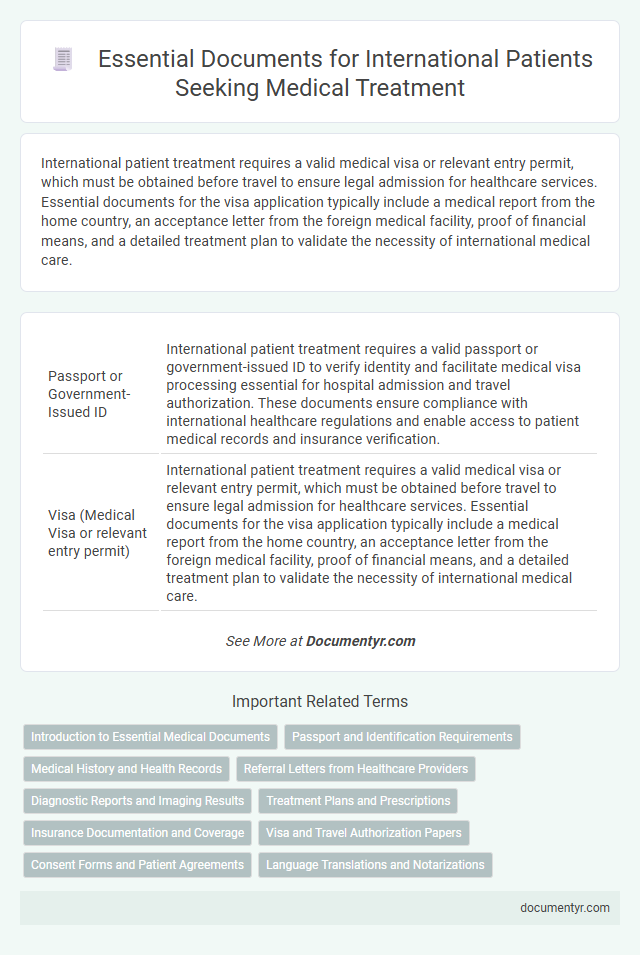
Essential documents for international patient treatment include a valid passport, medical records detailing the patient's history, diagnosis, and prior treatments, and a referral letter from the primary healthcare provider. Patients must also provide proof of travel insurance covering medical expenses and a signed consent form authorizing treatment abroad. In many cases, a visa and vaccination certificates may be required depending on the destination country's regulations.
What Documents Are Needed for International Patient Treatment?
| Number | Name | Description |
|---|---|---|
| 1 | Passport or Government-Issued ID | International patient treatment requires a valid passport or government-issued ID to verify identity and facilitate medical visa processing essential for hospital admission and travel authorization. These documents ensure compliance with international healthcare regulations and enable access to patient medical records and insurance verification. |
| 2 | Visa (Medical Visa or relevant entry permit) | International patient treatment requires a valid medical visa or relevant entry permit, which must be obtained before travel to ensure legal admission for healthcare services. Essential documents for the visa application typically include a medical report from the home country, an acceptance letter from the foreign medical facility, proof of financial means, and a detailed treatment plan to validate the necessity of international medical care. |
| 3 | Medical Reports (recent and historical) | Comprehensive medical reports, including recent diagnostic tests, treatment history, and documented progress, are essential for international patient treatment to facilitate accurate diagnosis and tailored care plans. Historical medical records help specialists understand chronic conditions and previous interventions, ensuring continuity and safety in cross-border healthcare management. |
| 4 | Diagnosis Certificate | A Diagnosis Certificate is a critical document for international patient treatment, providing detailed medical information about the patient's condition, including the diagnosis, test results, and treatment history. This certificate must be authenticated by certified medical professionals and translated into the destination country's official language to ensure clarity and acceptance by foreign healthcare providers. |
| 5 | Referral Letter from Local Doctor/Hospital | A referral letter from a local doctor or hospital is essential for international patient treatment, as it provides detailed medical history, diagnosis, and rationale for seeking specialized care abroad. This document facilitates accurate assessment by foreign medical teams and ensures continuity of care across healthcare systems. |
| 6 | Treatment Plan or Medical Recommendation | A detailed Treatment Plan or Medical Recommendation is essential for international patient treatment, outlining the diagnosis, recommended therapies, and expected outcomes to facilitate coordinated care. This document must be prepared by a licensed healthcare provider and translated into the receiving country's official language to ensure clear communication and adherence to local medical protocols. |
| 7 | Imaging Reports (X-ray, MRI, CT scan, Ultrasound) | International patient treatment requires detailed imaging reports such as X-ray, MRI, CT scan, and ultrasound to provide comprehensive diagnostic information for accurate assessment. High-quality, DICOM-compliant imaging files with detailed radiologist interpretations ensure effective cross-border medical consultations and treatment planning. |
| 8 | Laboratory Test Results | Laboratory test results are essential documents for international patient treatment, providing critical diagnostic information that guides physicians in developing accurate treatment plans. These results should include detailed reports of blood tests, imaging studies, pathology findings, and any other relevant analyses, complete with reference ranges and medical interpretations to ensure seamless clinical evaluation across healthcare systems. |
| 9 | Prescription Records | Prescription records for international patient treatment must include detailed medication history, dosage, frequency, and prescribing physician information, ensuring accurate continuity of care. These documents should be translated into the destination country's official language and comply with international medical standards to facilitate proper evaluation and administration. |
| 10 | Vaccination Records | Vaccination records are essential documents for international patient treatment, providing detailed immunization history that helps healthcare providers assess risks and prevent communicable diseases. Accurate and up-to-date vaccination documentation facilitates appropriate medical planning and compliance with destination country health regulations. |
| 11 | Health Insurance Documents | Health insurance documents required for international patient treatment typically include valid insurance cards, detailed policy information outlining coverage benefits, and pre-authorization letters when applicable. Comprehensive proof of insurance ensures timely approval of medical procedures and facilitates smooth communication between healthcare providers and insurance companies. |
| 12 | Financial Proof or Sponsorship Letter | International patient treatment requires submission of financial proof or a sponsorship letter to demonstrate the ability to cover medical expenses, including hospital bills, treatment costs, and accommodation. Valid documents often include bank statements, affidavits of financial support, or official sponsorship letters from recognized organizations or government bodies confirming financial responsibility. |
| 13 | Appointment Confirmation Letter | An Appointment Confirmation Letter is essential for international patient treatment as it verifies the scheduled medical appointment and provides details such as the date, time, and location of the healthcare facility. This document serves as official proof for visa applications and facilitates smooth coordination between the patient and medical provider. |
| 14 | Hospital Admission Letter | A Hospital Admission Letter is essential for international patient treatment, serving as official confirmation of the patient's acceptance and scheduled care at the medical facility. This document includes critical details such as patient identification, diagnosis, proposed treatment plan, and admission dates, ensuring smooth communication between healthcare providers and facilitating visa and insurance processes. |
| 15 | Consent Forms | Consent forms are essential documents required for international patient treatment, ensuring legal authorization for medical procedures and safeguarding patient rights. These forms must clearly outline the risks, benefits, and alternatives in the patient's native language to comply with international healthcare regulations and facilitate informed decision-making. |
| 16 | Travel Itinerary | A detailed travel itinerary including flight details, accommodation reservations, and transportation arrangements is essential for international patient treatment to ensure smooth coordination and timely access to medical facilities. This document helps medical providers plan patient care around arrival and departure times while facilitating visa applications and insurance approvals. |
| 17 | Emergency Contact Information | Emergency contact information is crucial for international patient treatment, including the full name, phone number, and relationship of the designated contact person to ensure swift communication during medical emergencies. Hospitals also require this information alongside patient identification documents and medical history to coordinate prompt care and consent processes effectively. |
| 18 | Previous Discharge Summaries | Previous discharge summaries are essential documents for international patient treatment, providing comprehensive records of past hospital admissions, diagnoses, treatments, and outcomes. These summaries enable healthcare providers to understand the patient's medical history, avoid duplicate tests, and tailor treatment plans effectively while ensuring continuity of care across different healthcare systems. |
| 19 | Translator or Interpreter Authorization (if required) | International patient treatment requires a certified translator or interpreter authorization when language barriers exist to ensure accurate communication of medical information. Hospitals often mandate official documentation verifying the linguistic credentials and confidentiality agreements of the translator or interpreter to comply with legal and medical standards. |
| 20 | Power of Attorney (if applicable) | Power of Attorney documents are essential for international patient treatment when a patient requires a legal representative to make medical decisions on their behalf, ensuring compliance with hospital policies and local regulations. This document must be properly notarized and translated into the destination country's official language to facilitate smooth communication between healthcare providers and the appointed agent. |
Introduction to Essential Medical Documents
| Document Type | Description | Importance for International Patients |
|---|---|---|
| Medical History Records | Comprehensive documentation of past illnesses, treatments, surgeries, allergies, and ongoing conditions. | Provides healthcare providers with essential background to tailor treatments and avoid adverse reactions. |
| Referral Letter | Official letter from a primary physician or specialist recommending specific treatment abroad. | Facilitates smoother admission processes and ensures the receiving medical facility understands the patient's condition. |
| Diagnostic Test Results | Reports from blood tests, imaging (X-rays, MRIs, CT scans), biopsies, and other diagnostic procedures. | Enables accurate diagnosis and treatment planning based on up-to-date clinical evidence. |
| Identification Documents | Passports, visas, and any medical insurance cards necessary for legal and administrative verification. | Essential for patient identification, hospital registration, and insurance claims processing. |
| Consent Forms | Legal documents where the patient or guardian authorizes medical procedures and data sharing. | Required to comply with medical ethics and international healthcare regulations. |
| Treatment Plan | A detailed outline proposed by the healthcare provider, including procedures, timelines, and medication. | Ensures patient understanding and agreement on the course of treatment, improving outcomes and satisfaction. |
Passport and Identification Requirements
What documents are essential for international patient treatment regarding passport and identification requirements? A valid passport is mandatory for verifying the patient's identity and nationality during medical appointments abroad. Official identification, such as a government-issued ID or national health card, is also required to facilitate medical record access and insurance validation.
Medical History and Health Records
Medical history and health records are essential documents for international patient treatment, providing a comprehensive overview of past and current health conditions. These records include previous diagnoses, treatments, surgical reports, and medication lists that help healthcare providers design accurate and effective treatment plans. Ensuring your complete and up-to-date medical history is submitted speeds up the evaluation process and improves care quality.
Referral Letters from Healthcare Providers
Referral letters from healthcare providers are essential documents for international patient treatment. These letters provide a detailed medical history and justify the need for specialized care abroad.
- Detailed Medical History - Referral letters include comprehensive information about your previous diagnoses, treatments, and current health status.
- Specialist Recommendations - Healthcare providers outline the necessity for specific consultations or procedures available only at the international facility.
- Continuity of Care - These letters facilitate communication between your local and international healthcare teams, ensuring consistent treatment plans.
Ensuring your referral letter is clear and complete accelerates the approval and scheduling of your international medical care.
Diagnostic Reports and Imaging Results
For international patient treatment, accurate and comprehensive medical documentation is essential. Diagnostic reports and imaging results play a critical role in ensuring proper evaluation and care.
- Diagnostic Reports - These include detailed lab test results, pathology reports, and physician notes that summarize your medical condition and previous treatments.
- Imaging Results - High-quality copies of X-rays, MRIs, CT scans, and ultrasound images provide visual evidence necessary for accurate diagnosis and treatment planning.
- Translated Documents - All diagnostic and imaging reports should be translated into the language used by the treatment center to avoid misinterpretation and delays.
Treatment Plans and Prescriptions
For international patient treatment, providing detailed treatment plans is essential to ensure continuity of care across borders. Prescriptions must clearly indicate medication names, dosages, and administration instructions, complying with both local and international medical regulations. You should prepare these documents accurately to facilitate effective communication between healthcare providers and avoid delays in therapy.
Insurance Documentation and Coverage
International patients must provide comprehensive insurance documentation to ensure coverage for medical treatments abroad. Proper insurance verification facilitates smooth billing and reduces financial risks during international medical care.
- Insurance Policy Copy - Patients need to submit a valid copy of their health insurance policy to confirm coverage details for overseas treatments.
- Pre-authorization Letter - A pre-authorization from the insurance provider is often required to approve and guarantee coverage for specific medical procedures.
- Coverage Confirmation - Documentation confirming the extent of coverage, including inpatient, outpatient, and emergency services, is essential for treatment planning.
Visa and Travel Authorization Papers
International patients seeking medical treatment abroad must secure appropriate visa and travel authorization papers prior to their journey. These documents validate the purpose of travel and ensure legal entry into the destination country.
A medical visa is often required, supported by official hospital invitation letters and proof of appointment. Travel authorization may include health insurance confirmation and compliance with entry health regulations such as vaccination records or COVID-19 test results.
Consent Forms and Patient Agreements
Consent forms are essential documents required for international patient treatment. These forms authorize medical professionals to provide specific treatments and ensure patients understand the risks involved.
Patient agreements outline the responsibilities and expectations between healthcare providers and patients. You must carefully review and sign these agreements to confirm your commitment to the treatment process.
What Documents Are Needed for International Patient Treatment? Infographic