To apply for medical disability benefits, you need comprehensive medical records including physician reports, diagnostic test results, and treatment history. Supporting documentation such as prescription histories, hospital discharge summaries, and statements from healthcare providers detailing the severity and impact of your condition are essential. Accurate and complete paperwork increases the likelihood of a successful application by clearly demonstrating the extent of your disability to the reviewing authorities.
What Documents Do You Need to Apply for Medical Disability Benefits?
| Number | Name | Description |
|---|---|---|
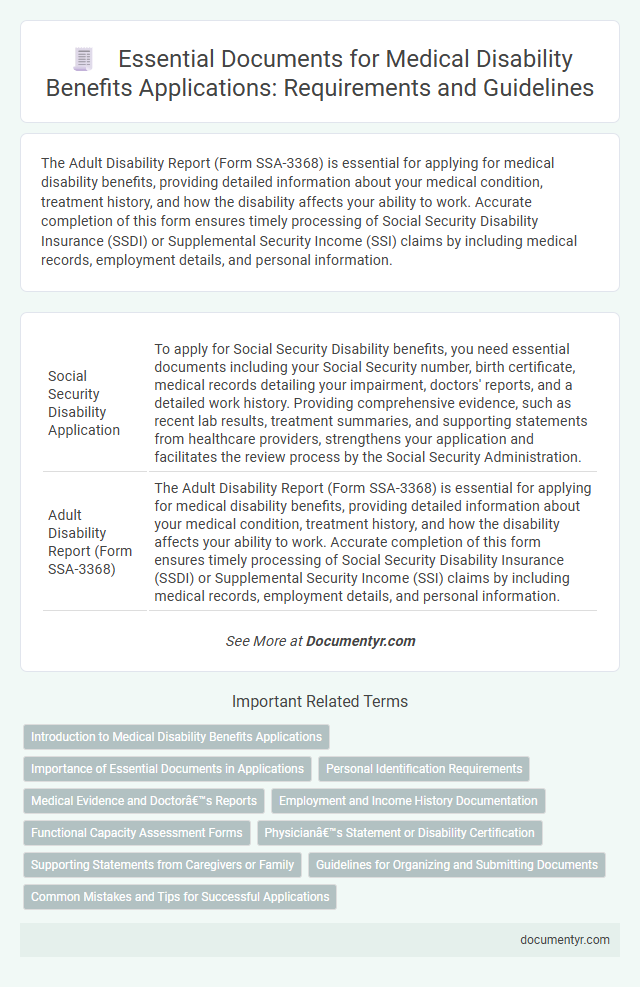
| 1 | Social Security Disability Application | To apply for Social Security Disability benefits, you need essential documents including your Social Security number, birth certificate, medical records detailing your impairment, doctors' reports, and a detailed work history. Providing comprehensive evidence, such as recent lab results, treatment summaries, and supporting statements from healthcare providers, strengthens your application and facilitates the review process by the Social Security Administration. |
| 2 | Adult Disability Report (Form SSA-3368) | The Adult Disability Report (Form SSA-3368) is essential for applying for medical disability benefits, providing detailed information about your medical condition, treatment history, and how the disability affects your ability to work. Accurate completion of this form ensures timely processing of Social Security Disability Insurance (SSDI) or Supplemental Security Income (SSI) claims by including medical records, employment details, and personal information. |
| 3 | Medical Records | Medical records are essential documents required to apply for medical disability benefits, providing detailed evidence of diagnosis, treatment history, and the severity of the medical condition. Comprehensive medical documentation from healthcare providers, including physician notes, hospital records, lab results, and imaging reports, strengthens the application by validating the disability claim. |
| 4 | Recent Laboratory and Test Results | Recent laboratory and test results, including blood work, imaging studies, and diagnostic reports, are essential documents when applying for medical disability benefits as they provide objective evidence of the medical condition's severity and progression. These results must be current, typically within the last six months, to accurately support the disability claim and demonstrate ongoing medical impairment. |
| 5 | Physician’s Statement | A Physician's Statement is a critical document required for medical disability benefits, providing detailed medical evidence of the applicant's diagnosis, prognosis, and functional limitations. This statement must be completed by a licensed healthcare provider and include objective findings, treatment history, and how the disability impairs the applicant's ability to work. |
| 6 | Hospital Discharge Summaries | Hospital discharge summaries are essential documents for applying for medical disability benefits, as they provide a comprehensive record of the patient's hospital stay, including diagnosis, treatment, and prognosis. These summaries help Disability Determination Services (DDS) verify medical conditions and assess the severity and impact on the applicant's ability to work. |
| 7 | Medication Lists | A comprehensive medication list is essential when applying for medical disability benefits, detailing all prescribed, over-the-counter, and herbal medications along with dosages and frequency. This list helps medical evaluators understand the claimant's treatment regimen and its impact on their functional limitations. |
| 8 | Treatment Histories | Comprehensive treatment histories, including detailed medical records, physician notes, and hospital discharge summaries, are essential to establish the severity and duration of the disability for medical disability benefits applications. Documentation should also include diagnostic test results and records of prescribed therapies to support the claim's validity and demonstrate ongoing medical care. |
| 9 | Work History Report (Form SSA-3369) | The Work History Report (Form SSA-3369) is essential for applying for medical disability benefits, as it provides detailed documentation of your previous job roles, tasks, and work activity over the past 15 years. This form helps the Social Security Administration evaluate your ability to perform past work and determine eligibility based on your medical condition's impact on your work capacity. |
| 10 | Proof of Identity (ID, Birth Certificate) | Essential documents for applying for medical disability benefits include proof of identity such as a government-issued ID card or driver's license, and an official birth certificate to verify age and citizenship status. These primary identification documents ensure accurate processing of disability claims and compliance with federal and state regulations. |
| 11 | Proof of U.S. Citizenship or Legal Resident Status | To apply for medical disability benefits, you must provide proof of U.S. citizenship through documents such as a birth certificate, U.S. passport, or Certificate of Naturalization, or proof of legal resident status via a permanent resident card (Green Card) or valid immigration documents. These documents establish your eligibility and are essential for the Social Security Administration's verification process. |
| 12 | Recent Pay Stubs or W-2 Forms | Recent pay stubs or W-2 forms are essential documents for applying for medical disability benefits as they provide verifiable proof of income and employment history. These records help disability determination services assess financial eligibility and ensure accurate benefit calculations. |
| 13 | Award Letters or Settlement Agreements (Other Benefits) | Award letters or settlement agreements from previous benefits, including workers' compensation, Social Security, or other insurance claims, are essential documents when applying for medical disability benefits, as they verify past approvals and payment histories. These documents provide critical evidence of disability status and financial awards, which can expedite the evaluation process and support claim validation. |
| 14 | Military Discharge Papers (DD-214, if applicable) | Military Discharge Papers, such as the DD-214 form, are essential for applying for medical disability benefits as they provide official proof of service and discharge status, which helps establish eligibility. This document includes critical service details like dates of service, rank, and type of discharge, which are necessary for the Veterans Affairs (VA) to process disability claims accurately. |
| 15 | Educational Records (if under 22) | Educational records, including Individualized Education Programs (IEPs), school transcripts, and attendance records, are essential for medical disability benefits applications for individuals under 22, as they provide detailed evidence of how a medical condition affects daily functioning and learning abilities. These documents support the evaluation of developmental delays, cognitive impairments, or other disabilities relevant to eligibility criteria. |
| 16 | Function Report (Adult) | The Function Report (Adult) is a critical document for applying for medical disability benefits, detailing how a claimant's impairments affect daily activities, mobility, and self-care abilities. Comprehensive and accurate responses in this report help the Social Security Administration evaluate the functional limitations caused by medical conditions. |
| 17 | Activities of Daily Living Questionnaire | The Activities of Daily Living (ADL) Questionnaire is a critical document in medical disability benefits applications, providing detailed information on an applicant's ability to perform everyday tasks such as bathing, dressing, and eating. This questionnaire helps medical reviewers assess the severity of the disability and its impact on the claimant's functional independence, directly influencing the eligibility decision. |
| 18 | Third-Party Observation Statement | A Third-Party Observation Statement is a critical document for medical disability benefits applications, providing firsthand accounts from individuals such as family members, caregivers, or healthcare professionals who observe the applicant's daily limitations and symptoms. This statement supplements medical records by offering detailed descriptions of the applicant's functional impairments and challenges, strengthening the overall evidence for disability claims. |
| 19 | Appointment of Representative Form (if using attorney/advocate) | When applying for medical disability benefits, submitting an Appointment of Representative Form (Form SSA-1696) is essential if you are using an attorney or advocate to handle your case, as it authorizes them to act on your behalf with the Social Security Administration. This form ensures that your representative can receive confidential information, communicate with the SSA, and manage your disability claim effectively. |
| 20 | Marriage and Divorce Certificates (if applicable) | Marriage and divorce certificates are crucial documents when applying for medical disability benefits, as they verify your marital status and can affect benefit eligibility and dependent considerations. These legal documents assist in determining spousal benefits, survivor benefits, and the allocation of medical funds among eligible family members. |
Introduction to Medical Disability Benefits Applications
Applying for medical disability benefits requires submitting specific documents that prove your medical condition and its impact on your ability to work. Key documents include medical records, physician statements, and employment history. Proper documentation ensures a smoother evaluation process by disability determination services.
Importance of Essential Documents in Applications
What documents do you need to apply for medical disability benefits? Essential documents provide proof of your medical condition and support your claim effectively. These records include medical histories, physician statements, and test results critical for verifying your disability status.
Personal Identification Requirements
When applying for medical disability benefits, personal identification is a crucial requirement to verify your identity accurately. Acceptable forms of ID typically include a government-issued photo identification such as a driver's license or passport.
Applicants may also need to provide their Social Security number and birth certificate to confirm their eligibility. Ensuring these documents are current and valid helps expedite the application process with medical disability programs.
Medical Evidence and Doctor’s Reports
Medical evidence is crucial for a successful medical disability benefits application. Documents such as detailed doctor's reports provide essential information about your condition and its impact on daily functioning.
Doctor's reports should include diagnosis, treatment history, and prognosis to support the disability claim. These reports must be current and authored by certified healthcare professionals for credibility.
Employment and Income History Documentation
| Document Type | Details | Purpose |
|---|---|---|
| Employment History Records | Statements from current and previous employers, including job titles, duties, and dates of employment. | Verifies work background and helps establish the impact of medical conditions on employment capabilities. |
| Pay Stubs and Earnings Statements | Recent pay stubs, W-2 forms, or tax returns showing income from the last two years. | Confirms income levels and supports financial eligibility for benefits. |
| Social Security Earnings Statement | Official statement from the Social Security Administration detailing lifetime earnings. | Provides a comprehensive overview of employment history and income for benefit calculation. |
| Self-Employment Records | Business tax returns, profit and loss statements, or 1099 forms for self-employed individuals. | Documents income and employment status when traditional pay stubs are unavailable. |
Functional Capacity Assessment Forms
Functional Capacity Assessment Forms are crucial documents when applying for medical disability benefits. These forms provide detailed insights into an individual's physical and mental limitations affecting their ability to work.
- Comprehensive Evaluation - Functional Capacity Assessment Forms include evaluations of mobility, strength, endurance, and cognitive functions relevant to daily tasks.
- Medical Professional Input - These forms are completed by qualified healthcare providers to ensure accurate representation of the claimant's functional impairments.
- Benefit Eligibility Support - Clear documentation in Functional Capacity Assessment Forms helps establish the extent of disability necessary for benefit approval.
Physician’s Statement or Disability Certification
To apply for medical disability benefits, a Physician's Statement or Disability Certification is a critical document. This statement must detail the nature of your medical condition, its severity, and how it impairs your ability to work. Accurate and thorough certification from a licensed healthcare provider strengthens your application and speeds up the approval process.
Supporting Statements from Caregivers or Family
Supporting statements from caregivers or family members are crucial when applying for medical disability benefits. These documents provide firsthand accounts of the applicant's daily challenges and medical needs.
- Caregiver Statement - Describes the extent of assistance required for daily activities and the impact of the disability on routine tasks.
- Family Member Testimony - Offers insight into behavioral changes and emotional support needs related to the medical condition.
- Observation Reports - Provide detailed records of symptoms, medication effects, and changes in physical or mental health over time.
Guidelines for Organizing and Submitting Documents
When applying for medical disability benefits, it is essential to gather all relevant medical records, physician statements, and proof of income. Organizing these documents systematically ensures a smoother review process by the disability benefits office.
Start by categorizing documents into medical evidence, financial information, and personal identification. Label each file clearly and create a checklist to track submitted and pending documents. Submitting copies rather than originals helps preserve the original records and prevents loss during processing.
What Documents Do You Need to Apply for Medical Disability Benefits? Infographic