An employment verification letter typically requires documents such as a government-issued ID, recent pay stubs, and proof of employment like a contract or offer letter. Employers may also request tax forms, bank statements, or HR records to confirm salary and job status. Providing accurate and up-to-date documentation ensures a swift and reliable verification process.
What Documents Do You Need for an Employment Verification Letter?
| Number | Name | Description |
|---|---|---|
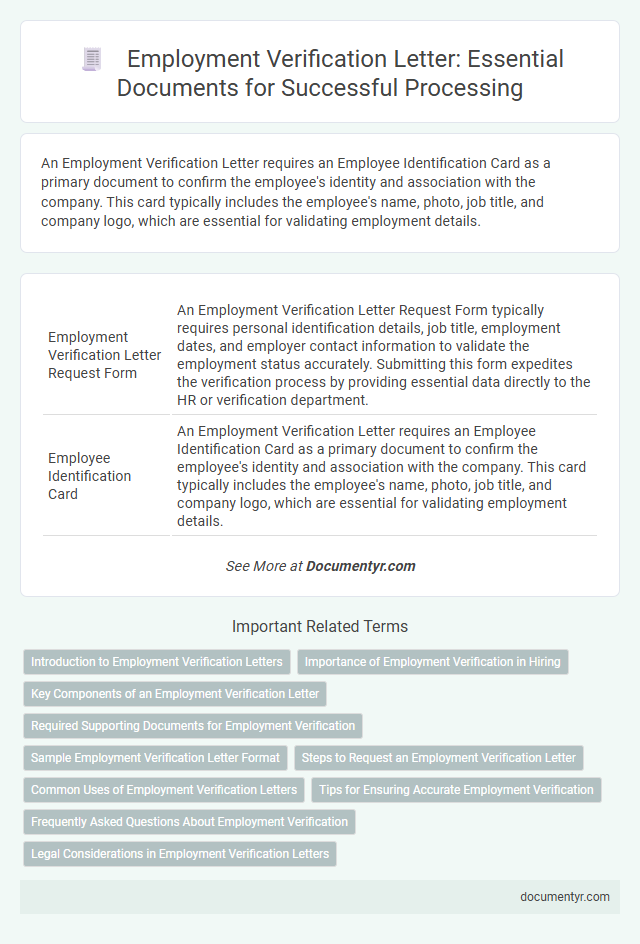
| 1 | Employment Verification Letter Request Form | An Employment Verification Letter Request Form typically requires personal identification details, job title, employment dates, and employer contact information to validate the employment status accurately. Submitting this form expedites the verification process by providing essential data directly to the HR or verification department. |
| 2 | Employee Identification Card | An Employment Verification Letter requires an Employee Identification Card as a primary document to confirm the employee's identity and association with the company. This card typically includes the employee's name, photo, job title, and company logo, which are essential for validating employment details. |
| 3 | Government-issued Photo ID (e.g., Passport, Driver’s License) | A Government-issued Photo ID, such as a Passport or Driver's License, is essential for employment verification to confirm identity and eligibility to work. Employers require these documents to comply with legal regulations and prevent identity fraud during the hiring process. |
| 4 | Offer Letter or Employment Contract | An Employment Verification Letter typically requires an Offer Letter or Employment Contract to confirm job title, start date, and salary details. These documents provide verified information essential for validating employment status with hiring organizations or financial institutions. |
| 5 | Recent Pay Stubs | Recent pay stubs are essential documents for an employment verification letter as they provide up-to-date proof of income and employment status. Employers and verification agencies rely on these pay stubs to confirm salary details, job title, and continuous employment, ensuring accuracy and legitimacy in the verification process. |
| 6 | Tax Identification Number (TIN) | An Employment Verification Letter often requires the employee's Tax Identification Number (TIN) to accurately confirm their identity and tax status for legal and payroll purposes. Including the TIN ensures compliance with tax regulations and facilitates verification by government agencies or financial institutions. |
| 7 | Social Security Number (SSN) | An Employment Verification Letter typically requires the employee's Social Security Number (SSN) to accurately confirm identity and employment details with the requesting party. Providing the SSN ensures that the verification process complies with legal standards and prevents errors in employment records. |
| 8 | Recent Tax Return (W-2, 1099) | Recent tax return documents such as W-2 and 1099 forms are essential for employment verification letters as they provide official proof of income and employment status. These documents help employers and third parties confirm the employee's earnings, tax contributions, and job legitimacy. |
| 9 | Bank Account Statement (for salary verification) | A bank account statement is crucial for employment verification letters as it provides concrete evidence of salary deposits, confirming the authenticity of income claims. Employers use these statements to verify salary consistency and validate the employee's financial stability. |
| 10 | Work Authorization Document (for non-citizens) | A Work Authorization Document, such as an Employment Authorization Document (EAD) or valid visa, is essential for employment verification letters to confirm a non-citizen's legal permission to work in the country. Employers typically require these documents alongside identification and job offer letters to ensure compliance with labor and immigration laws. |
| 11 | Human Resources Contact Information | Employment verification letters require detailed human resources contact information, including the HR representative's full name, job title, direct phone number, and official email address, to ensure authenticity and facilitate follow-up communication. Accurate HR contacts enable employers or third parties to validate employment status and other relevant details efficiently. |
| 12 | Job Title and Job Description Documentation | Employment verification letters require precise documentation of the employee's job title to confirm their position within the company, ensuring accurate representation of their role. Detailed job description documentation supports the verification process by outlining specific duties and responsibilities, validating the employee's work scope for prospective employers or institutions. |
| 13 | Dates of Employment Record | Employment verification letters require precise dates of employment, including the start and end dates, to confirm the candidate's tenure accurately. These records are crucial for validating job stability, work history, and eligibility for benefits or rehiring considerations. |
| 14 | Salary or Compensation Record | An employment verification letter typically requires submission of recent salary or compensation records, including pay stubs, W-2 forms, or official payroll statements to confirm income details. These documents validate the employee's earnings history and assist employers or third parties in assessing financial reliability. |
| 15 | Supervisor or Manager Reference Letter | A Supervisor or Manager Reference Letter for employment verification typically requires documents such as the employee's job description, performance reviews, dates of employment, and proof of job title from HR records. This letter should also include contact information for the supervisor or manager to validate the authenticity of the employment details. |
| 16 | Company Letterhead for Official Correspondence | An employment verification letter must be printed on the company letterhead to ensure authenticity and professionalism, including the company's name, logo, address, and contact details. Using official company letterhead helps verify the legitimacy of the document and provides recipients with reliable information for employment confirmation. |
Introduction to Employment Verification Letters
Employment verification letters confirm an individual's current or past job status. These documents are essential for loan applications, rental agreements, and background checks. Providing accurate employment information ensures trust and transparency between employers and third parties.
Importance of Employment Verification in Hiring
What documents do you need for an employment verification letter? Providing accurate documents, such as pay stubs, tax forms, or a contract, helps confirm job details. Employment verification is crucial in hiring to ensure the candidate's work history is legitimate and matches their claims.
Key Components of an Employment Verification Letter
An employment verification letter must include specific key components to serve its purpose effectively. These components confirm an individual's job status, salary, and duration of employment.
The letter should state the employee's full name, job title, and dates of employment clearly. It must also include the employer's contact information and signature for authenticity.
Required Supporting Documents for Employment Verification
Employment verification letters require specific supporting documents to confirm job status and history. Providing accurate documents ensures a smooth verification process.
- Identification Proof - A valid government-issued ID such as a driver's license or passport is necessary for identity confirmation.
- Employment Contract - The original or a copy of your employment agreement verifies terms and job position.
- Payroll Records - Recent pay stubs or salary slips establish proof of ongoing or past employment and income details.
Submitting these documents helps verify employment status efficiently and accurately.
Sample Employment Verification Letter Format
An employment verification letter typically requires essential documents such as a government-issued ID, recent pay stubs, and proof of employment like an employment contract or offer letter. These documents help confirm the employee's identity, job status, and income details accurately.
Below is a sample employment verification letter format that includes the employee's full name, job title, dates of employment, and salary information. The letter should be printed on company letterhead, signed by an authorized representative, and dated for authenticity.
Steps to Request an Employment Verification Letter
To request an employment verification letter, start by contacting your human resources department or your direct supervisor. Provide essential details such as your full name, job title, dates of employment, and the purpose of the verification letter. Ensure you specify any particular information or format required by the requesting party to expedite the process.
Common Uses of Employment Verification Letters
An employment verification letter confirms an individual's current or past job status for various purposes. It typically requires specific documents to ensure accurate and official information is provided.
- Proof of Identity - A government-issued ID such as a passport or driver's license verifies the employee's identity.
- Employment Details - Pay stubs, offer letters, or contracts confirm job title, dates of employment, and salary.
- Request Form or Authorization - A completed form or written consent from the employee authorizes the employer to release their employment information.
Tips for Ensuring Accurate Employment Verification
An employment verification letter requires specific documents to confirm the authenticity of the applicant's work history. Key documents include pay stubs, tax records, and official employment contracts.
Provide accurate personal information such as full name, social security number, and employment dates to avoid discrepancies. Verify employer contact details, including HR department phone numbers and addresses, for direct confirmation. Maintain organized records and request letters on company letterhead to ensure legitimacy and professionalism.
Frequently Asked Questions About Employment Verification
An employment verification letter requires specific documents to confirm job status and details. These documents ensure accuracy and authenticity for the requesting party.
- Recent Pay Stubs - Pay stubs provide proof of current earnings and employment dates.
- Employment Contract or Offer Letter - This document verifies job title, start date, and employment terms.
- Employer Contact Information - Providing official contact details allows verification of the letter's legitimacy.
What Documents Do You Need for an Employment Verification Letter? Infographic