Fertility treatment approval requires essential documents including a valid identification card, medical history reports, and recent fertility assessments such as hormone levels and ultrasound results. Couples may need to provide proof of marriage or partnership and consent forms confirming understanding of the procedures involved. These documents ensure accurate evaluation and facilitate compliance with medical and legal standards for treatment authorization.
What Documents are Required for Fertility Treatment Approval?
| Number | Name | Description |
|---|---|---|
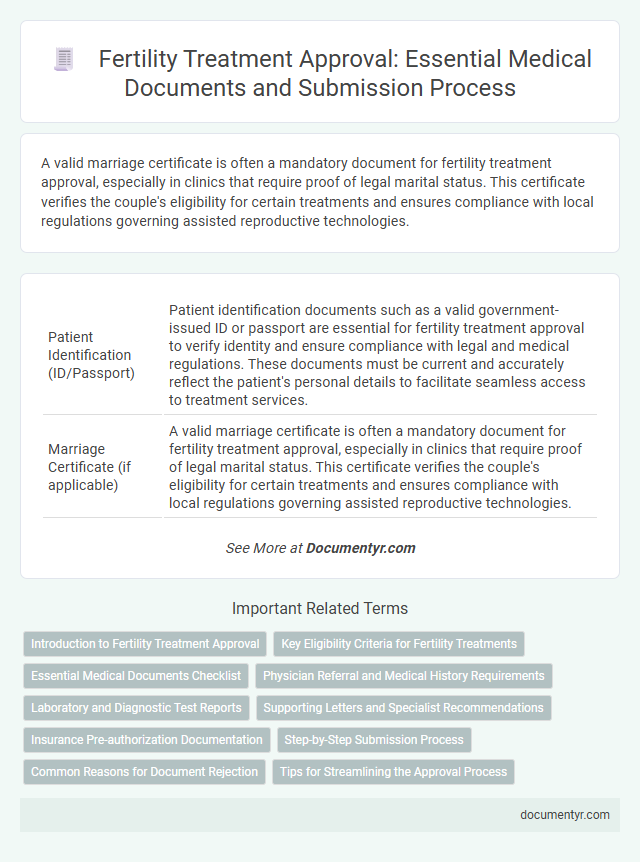
| 1 | Patient Identification (ID/Passport) | Patient identification documents such as a valid government-issued ID or passport are essential for fertility treatment approval to verify identity and ensure compliance with legal and medical regulations. These documents must be current and accurately reflect the patient's personal details to facilitate seamless access to treatment services. |
| 2 | Marriage Certificate (if applicable) | A valid marriage certificate is often a mandatory document for fertility treatment approval, especially in clinics that require proof of legal marital status. This certificate verifies the couple's eligibility for certain treatments and ensures compliance with local regulations governing assisted reproductive technologies. |
| 3 | Referral Letter from Primary Care/OB-GYN | A referral letter from a primary care physician or OB-GYN is essential for fertility treatment approval, detailing the patient's medical history, previous treatments, and justification for specialist intervention. This document ensures accurate diagnosis and eligibility verification, facilitating timely access to advanced reproductive care. |
| 4 | Previous Medical Records | Previous medical records, including comprehensive fertility evaluations, hormone test results, ultrasound reports, and any prior treatment history, are essential for fertility treatment approval. These documents provide critical clinical data that help specialists assess underlying conditions and tailor personalized treatment plans. |
| 5 | Prior Fertility Treatment Records | Medical records documenting previous fertility treatments, including hormone therapy details, IVF protocols, and embryo transfer reports, are essential for fertility treatment approval. Insurance providers and clinics require comprehensive prior treatment records to evaluate patient history and tailor personalized fertility care plans. |
| 6 | Diagnostic Test Results (Hormone Levels, Semen Analysis, Ultrasound) | Diagnostic test results, including detailed hormone level reports, semen analysis, and ultrasound imaging, are essential for fertility treatment approval to assess reproductive health accurately. These documents provide critical data for identifying underlying conditions and tailoring effective fertility interventions. |
| 7 | Consent Forms for Treatment Procedures | Consent forms for fertility treatment procedures are essential documents required for treatment approval, ensuring patients understand and agree to the medical interventions involved. These forms typically include detailed information on risks, benefits, alternatives, and confirmation of voluntary participation, which complies with legal and ethical standards in reproductive healthcare. |
| 8 | Insurance Authorization Letter | An Insurance Authorization Letter is a critical document required for fertility treatment approval, serving as formal proof that the insurer has reviewed and approved the specific procedures. This letter typically includes patient details, coverage limits, treatment codes, and authorization validity dates, ensuring compliance with insurance policies and facilitating smooth claim processing. |
| 9 | Financial Disclosure or Payment Agreement | Financial disclosure forms and signed payment agreements are essential documents required for fertility treatment approval, ensuring transparent communication of costs and patient responsibility. These documents typically include detailed breakdowns of treatment fees, insurance coverage limitations, and payment schedules to prevent billing misunderstandings. |
| 10 | Genetic Screening Reports (if required) | Fertility treatment approval often requires submission of genetic screening reports to assess hereditary risks and ensure the health of both parents and offspring. These reports typically include carrier screening results, karyotyping analysis, and any relevant family genetic history documentation mandated by the clinic or regulatory guidelines. |
| 11 | Infectious Disease Screening Reports | Infectious disease screening reports are essential for fertility treatment approval, typically including tests for HIV, hepatitis B and C, syphilis, and other communicable infections to ensure patient and donor safety. These reports must be recent, certified by an accredited laboratory, and comply with local regulatory guidelines to prevent transmission risks during assisted reproductive procedures. |
| 12 | Psychological Evaluation Report (if required) | A Psychological Evaluation Report may be required for fertility treatment approval to assess the emotional and mental readiness of patients undergoing assisted reproductive procedures. This standardized document, prepared by a licensed mental health professional, evaluates psychological stability, coping mechanisms, and support systems to ensure treatment suitability and optimize outcomes. |
| 13 | Partner’s Medical Records | Partner's medical records are essential for fertility treatment approval and typically include a comprehensive health history, recent test results such as blood work and infectious disease screenings, and documented fertility assessments like semen analysis. These documents help clinicians evaluate combined reproductive health factors to tailor appropriate treatment plans and ensure safety for both partners. |
| 14 | Legal Documents for Third-party Reproduction (if applicable) | Legal documents for third-party reproduction typically include a notarized consent form, a parentage agreement, and a medical history disclosure to ensure all parties understand their rights and responsibilities. Courts may also require a court order or pre-birth order to establish parental rights before proceeding with fertility treatment. |
| 15 | Vaccination Records | Vaccination records are essential for fertility treatment approval to ensure patients are protected against infectious diseases such as rubella, varicella, and hepatitis B, which can affect pregnancy outcomes. Clinics typically require up-to-date immunization documentation to reduce risks and comply with medical safety protocols. |
Introduction to Fertility Treatment Approval
| Introduction to Fertility Treatment Approval | |
|---|---|
| Fertility treatment approval involves a thorough evaluation process to ensure all necessary medical and legal requirements are met. Securing approval helps streamline access to appropriate fertility therapies and supports personalized patient care. Understanding the required documentation increases efficiency and facilitates communication between healthcare providers, patients, and insurance companies. | |
| Document Type | Purpose |
| Medical History Records | Provide comprehensive background on reproductive health, previous treatments, and any relevant medical conditions. |
| Diagnostic Test Results | Include hormone profiles, ultrasound reports, semen analysis, and other fertility-related diagnostic findings. |
| Physician's Referral or Recommendation | Confirms the necessity of fertility treatment based on medical evaluation and diagnosis. |
| Insurance Authorization Forms | Facilitate coverage approval and outline the extent of your insurance benefits for fertility procedures. |
| Consent Forms | Ensure informed consent regarding the treatment process, potential risks, and outcomes. |
Key Eligibility Criteria for Fertility Treatments
Fertility treatment approval requires submission of specific medical documents, including comprehensive fertility evaluations, hormonal profiles, and ultrasound reports that confirm reproductive health status. Key eligibility criteria commonly involve age limits, diagnosis of infertility causes, and previous treatment history documented by healthcare professionals. Insurance providers or clinics may also request evidence of partner fertility status and pre-existing medical conditions affecting pregnancy outcomes.
Essential Medical Documents Checklist
Fertility treatment approval requires a precise set of medical documents to ensure accurate diagnosis and appropriate care. Essential documents include detailed medical history, hormonal profiles, and diagnostic imaging reports.
Both partners must provide recent blood tests, including fertility hormone levels and infectious disease screening. Additional paperwork often involves prior treatment records and a formal referral from a gynecologist or fertility specialist.
Physician Referral and Medical History Requirements
What documents are required for fertility treatment approval regarding physician referral and medical history? A detailed physician referral is essential to initiate fertility treatment approval, ensuring that a specialist has evaluated the patient's condition. Comprehensive medical history records must include previous treatments, underlying health conditions, and reproductive health details to support the approval process.
Laboratory and Diagnostic Test Reports
Laboratory and diagnostic test reports play a crucial role in securing approval for fertility treatment. Your healthcare provider requires detailed and accurate test results to assess your reproductive health and tailor the treatment effectively.
- Hormonal Profile - Includes blood tests measuring levels of hormones such as FSH, LH, and AMH to evaluate ovarian function.
- Ultrasound Imaging - Reports from pelvic ultrasounds provide insights into the structure of ovaries and uterus, identifying any abnormalities.
- Infectious Disease Screening - Laboratory test results detecting infections like HIV, Hepatitis B/C, and other STIs ensure safety during treatment procedures.
Supporting Letters and Specialist Recommendations
For fertility treatment approval, submitting comprehensive supporting letters and specialist recommendations is essential. These documents validate the medical necessity and guide treatment protocols.
- Supporting Letters from Primary Care Physicians - Detail patient history and initial fertility concerns to establish a baseline for specialist evaluation.
- Endocrinologist Recommendations - Provide expert analysis of hormonal factors affecting fertility and propose tailored treatment plans.
- Reproductive Specialist Reports - Summarize diagnostic findings such as ultrasound and semen analysis to justify specific fertility interventions.
Accurate and detailed documentation accelerates approval and ensures appropriate fertility care management.
Insurance Pre-authorization Documentation
Insurance pre-authorization is a critical step for obtaining approval for fertility treatment. The required documentation ensures your insurance provider can evaluate and approve coverage before treatment begins.
- Physician's Detailed Treatment Plan - A comprehensive outline from your fertility specialist detailing the proposed procedures and medical necessity.
- Medical Records and Diagnostic Tests - Recent lab results, hormone profiles, and imaging reports supporting the diagnosis of infertility.
- Insurance Pre-authorization Form - A specific form provided by your insurer that must be completed and submitted to initiate the approval process.
Step-by-Step Submission Process
Fertility treatment approval requires precise documentation to ensure eligibility and compliance with medical guidelines. Collecting and submitting these documents correctly streamlines the approval process.
Step one involves obtaining a referral or prescription from a certified fertility specialist detailing the recommended treatments. Step two requires submitting your identification proof and medical insurance documents to verify identity and coverage.
Next, provide recent medical history records including hormonal tests, ultrasound reports, and previous fertility treatments if any. Step four is to complete specific consent forms and treatment authorization paperwork as mandated by the healthcare provider.
Common Reasons for Document Rejection
Fertility treatment approval requires submitting medical records, identification proof, and insurance documents. Common reasons for document rejection include incomplete forms, expired identification, and mismatched medical information. Ensuring your paperwork is accurate and up-to-date helps avoid delays in the approval process.
What Documents are Required for Fertility Treatment Approval? Infographic