To apply for food stamps, applicants must provide proof of identity, residency, and income, such as a government-issued ID, utility bills, and recent pay stubs. Documentation of household expenses, including rent or mortgage statements and utility bills, is often required to determine eligibility. Social Security numbers for all household members and immigration status verification documents may also be necessary.
What Documents Are Needed to Apply for Food Stamps?
| Number | Name | Description |
|---|---|---|
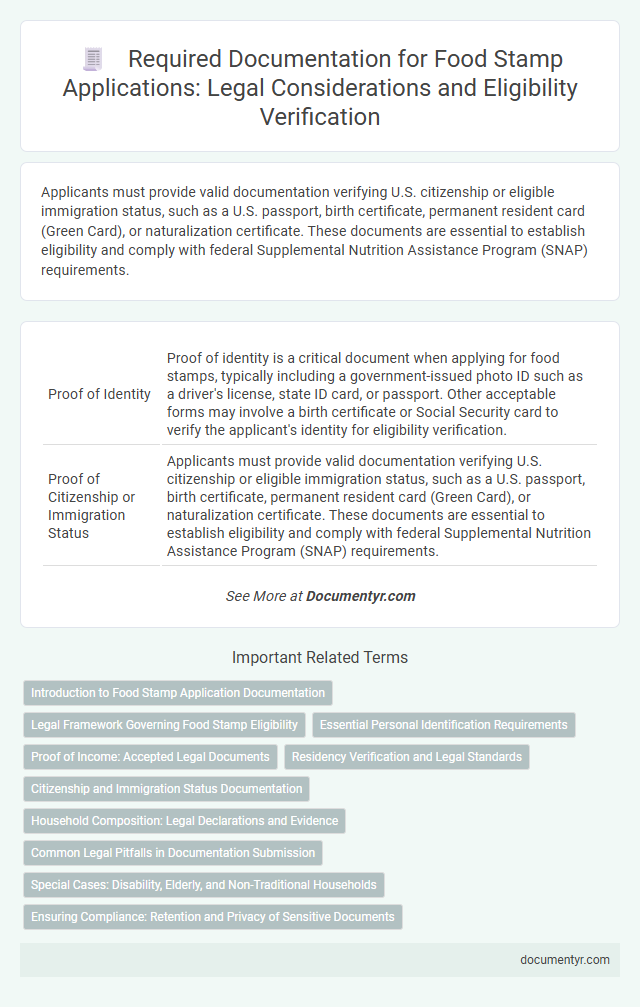
| 1 | Proof of Identity | Proof of identity is a critical document when applying for food stamps, typically including a government-issued photo ID such as a driver's license, state ID card, or passport. Other acceptable forms may involve a birth certificate or Social Security card to verify the applicant's identity for eligibility verification. |
| 2 | Proof of Citizenship or Immigration Status | Applicants must provide valid documentation verifying U.S. citizenship or eligible immigration status, such as a U.S. passport, birth certificate, permanent resident card (Green Card), or naturalization certificate. These documents are essential to establish eligibility and comply with federal Supplemental Nutrition Assistance Program (SNAP) requirements. |
| 3 | Social Security Number | Applicants must provide their Social Security Number (SSN) as a key identification document when applying for food stamps to verify eligibility and prevent fraud. The SSN is required for all household members applying for benefits, ensuring accurate income and identity verification in accordance with federal guidelines. |
| 4 | Proof of Residency | Proof of residency is a crucial document for food stamp applications, typically requiring a government-issued ID, utility bills, lease agreements, or official mail with the applicant's name and current address. These documents verify the applicant's residence within the state or county jurisdiction, ensuring eligibility for the Supplemental Nutrition Assistance Program (SNAP). |
| 5 | Proof of Income | Proof of income documents required to apply for food stamps typically include recent pay stubs, tax returns, Social Security benefits statements, and unemployment benefit letters. Accurate verification of income helps determine eligibility and benefit amount under the Supplemental Nutrition Assistance Program (SNAP). |
| 6 | Proof of Expenses (Bills, Rent, Utilities) | Proof of expenses for food stamp applications typically includes recent bills, rental agreements, and utility statements such as electricity, water, or gas bills to verify housing and living costs. Submitting these documents helps establish the applicant's eligibility by confirming actual monthly expenditures required to calculate benefit amounts accurately. |
| 7 | Proof of Household Size | Proof of household size for food stamp applications requires documentation such as rental agreements, utility bills, or official government correspondence listing all members residing in the home. Legal affidavits or school records may also be accepted to verify the number of individuals sharing resources within the household. |
| 8 | Proof of Disability (if applicable) | Applicants seeking food stamps who have a disability must provide official documentation such as a Social Security Disability Insurance (SSDI) award letter, Supplemental Security Income (SSI) approval notice, or a statement from a licensed medical professional confirming the disability. These documents serve as proof of disability to qualify for potential additional benefits or exemptions under the Supplemental Nutrition Assistance Program (SNAP) guidelines. |
| 9 | Proof of Child Support Payments (if applicable) | When applying for food stamps, proof of child support payments is required to verify income and eligibility, typically including court orders, payment receipts, or official statements from the child support enforcement agency. Providing accurate documentation ensures proper calculation of benefits and compliance with program regulations. |
| 10 | Proof of Educational Expenses (if applicable) | Applicants must provide detailed proof of educational expenses such as tuition receipts, enrollment verification letters, or official statements from educational institutions to qualify for food stamps benefits. These documents substantiate claims for deductions or allowances related to educational costs in the eligibility assessment process. |
| 11 | Proof of Medical Expenses (for elderly or disabled applicants) | Proof of medical expenses for elderly or disabled applicants applying for food stamps includes receipts, bills, or statements verifying out-of-pocket costs such as prescription medications, medical equipment, or long-term care services. These documents must clearly detail the expense amounts and dates to be accepted as valid evidence in the Supplemental Nutrition Assistance Program (SNAP) application process. |
Introduction to Food Stamp Application Documentation
Applying for food stamps requires submitting specific documents to verify eligibility. These documents typically include proof of identity, income, and residency. Understanding which papers are needed streamlines the application process and ensures timely assistance.
Legal Framework Governing Food Stamp Eligibility
| Document Type | Purpose | Legal Reference |
|---|---|---|
| Proof of Identity | Confirms applicant's identity to prevent fraud and ensure proper benefit distribution. | 42 U.S.C. SS 1786 - Verification requirements for eligibility |
| Proof of Residency | Establishes that the applicant lives in the state where benefits are requested. | 7 CFR SS 273.2(f) - Residency requirements |
| Proof of Income | Documents income sources to determine eligibility based on financial need. | 7 CFR SS 273.9 - Income verification |
| Proof of Household Composition | Details household members to calculate benefit allotment correctly. | 7 CFR SS 273.1(c) - Definition of household |
| Social Security Number (SSN) | Required for each household member applying or included in the case. | 42 U.S.C. SS 1382b(a) - SSN provision |
| Immigration Status Documentation | Verifies lawful presence as eligibility is limited to qualified non-citizens and citizens. | 8 U.S.C. SS 1613 - Restrictions on eligibility for immigrants |
| Expense Verification (Rent, Utilities, Child Care) | Supports deduction claims to calculate net income for benefit determination. | 7 CFR SS 273.9(d) - Deductible expenses |
| Work Registration Documents (if applicable) | Proof of registration or exemption from work requirements as per program guidelines. | 7 CFR SS 273.7 - Work registration program |
Essential Personal Identification Requirements
Applicants seeking food stamps must provide essential personal identification documents to verify their identity and eligibility. These documents help confirm residency, income, and citizenship or legal status.
Primary identification includes a government-issued photo ID such as a driver's license or state ID card. Proof of Social Security number, like a Social Security card or tax documents, is also required. Additionally, applicants must submit proof of residency, such as a utility bill or lease agreement, and documentation of income, including pay stubs or benefit award letters.
Proof of Income: Accepted Legal Documents
Proof of income is essential when applying for food stamps to verify your financial eligibility. Various legal documents can serve as acceptable evidence of income during the application process.
- Pay stubs - Recent pay stubs provide a clear record of your earned wages over a specific period.
- Tax returns - Filed IRS tax returns confirm yearly income and may include wages, self-employment earnings, or other sources.
- Benefit award letters - Official statements from Social Security, unemployment, or disability benefits show non-employment income receipts.
Residency Verification and Legal Standards
To apply for food stamps, verifying your residency is a crucial step in the legal process. Documents such as a lease agreement, utility bills, or a government-issued ID with your current address serve as primary proof of residency.
Legal standards require strict documentation to prevent fraud and ensure eligibility compliance. Submitting accurate and up-to-date residency verification supports a smooth application process under these regulations.
Citizenship and Immigration Status Documentation
When applying for food stamps, you must provide documentation proving your citizenship or immigration status. Acceptable documents include a U.S. passport, birth certificate, or naturalization papers for citizens.
Non-citizens must present immigration documents such as a green card, work permit (Employment Authorization Document), or valid visa. These documents verify eligibility and are essential for the application process.
Household Composition: Legal Declarations and Evidence
Applying for food stamps requires specific legal declarations and evidence to verify household composition. Accurate documentation ensures eligibility and proper benefit allocation.
- Proof of Identity - Government-issued ID or legal documents confirm the identity of all household members.
- Household Member Declarations - Signed statements declaring who lives in the household establish household size and relationships.
- Supporting Evidence - Lease agreements, utility bills, or school records provide additional proof of residency and household members.
Submitting complete and truthful household composition documentation is essential for a successful food stamp application.
Common Legal Pitfalls in Documentation Submission
Applying for food stamps requires submitting accurate and complete documentation to avoid delays or denials. Common legal pitfalls in documentation submission can result in application rejections or legal disputes.
- Incomplete Proof of Identity - Submitting expired or unclear identification documents can invalidate your application and slow down processing times.
- Incorrect Income Documentation - Providing outdated or mismatched income statements may lead to miscalculation of benefits or disqualification.
- Failure to Submit Proof of Residency - Omitting current proof of residence can cause your application to be rejected due to inability to verify eligibility.
Special Cases: Disability, Elderly, and Non-Traditional Households
Applying for food stamps in special cases such as disability, elderly, or non-traditional households requires specific documentation. Proof of disability may include medical records or Social Security Disability Insurance (SSDI) award letters. Elderly applicants need identification and income verification, while non-traditional households must provide documentation proving household composition and financial support arrangements.
What Documents Are Needed to Apply for Food Stamps? Infographic